
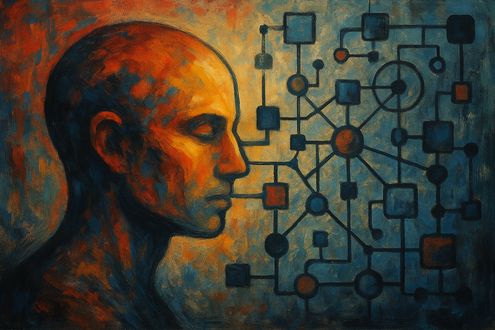
Scientific work is changing faster today than at any moment since the rise of digital libraries. For decades, researchers relied on slow, manual literature searches, painstaking note-taking, and endless hours improving clarity, grammar, formatting, and citations. For centuries before that, science was generally defined by its scarcity of: information, access, capacity, experts and of course time. This has led to a certain feeling that science is something only the elites can do, takes time and is very vigorous intellectual work. Almost none of that is relevant anymore in the age of AI and a fundamentally democratized age of information.
Information has gone from being scarce to being abundant. Attention on the other hand has become scarce. Knowledge is now completely accessible and only asking the right questions has become hard again. What artificial intelligence has introduced is not a shortcut, but a profound shift in what researchers are able to do with their time, attention and intellectual energy. This inversion has transformed everything from how we teach, to how we learn, do research and of course understand what even a “scientist” is anymore. In that way it impacts the entirety of the scientific community and science in general. What’s left of science is to produce the data, make the experiment, ask the questions, be creative. The rest and everything inbetween can be done by AI.
We are in a weird transition phase, where we use most of these tools to replicate a manual process in order to improve the quality and speed of production, while at the same time keeping the illusion alive, that we are doing it all by hand. This seems like a collective epistemic performance – a soft illusion if you want – that we maintain because the system/society around us still depends on old definitions of expertise. There’s prestige economy (as if science is built on the myth of “individually brilliant minds”) and assessment structures (because universities don’t yet know how to evaluate work when machines assist the process), identity protection (ego-dripping researchers who are afraid to lose their status) and general anxiety about automation (we need to confront ourselves with the uncomfortable questions of authorship, insight and originality more than ever). Once we allow ourselves to let go of these old paradigms and shift towards a scientific process with AI at the heart, in its core and DNA – then, and only then – will the effects truly show and shine.
And while AI is great at recognizing patterns, clustering information and sorting enormous quantities of data, it still struggles – and probably always will struggle with – is the spark of creative discontinuity:
- Connecting two ideas that no statistical model would link
- Taking intellectual risks
- Formulating provocative hypotheses
- Reframing problems in radically new ways
To understand this shift not just as a philosophical curiosity but as a practical transformation, we need to move from abstraction to application. The real revolution is not happening in theories of knowledge – it is happening in the everyday tools that silently reshape how scientific work is done.
For centuries, the identity of a “researcher” was defined by what humans had to do manually: read, extract, cluster, compare, write, revise, and justify. These activities were scholarship. Today, however, the essence of academic labor is no longer in the mechanical process, but in the cognitive choices that surround it. AI systems now perform many of the tasks that once defined scientific expertise, but they do so invisibly, in the background, dissolving the boundaries between intellectual work and computational support.
This is why the real question is not whether AI changes science, but how deeply it has already rewired it, often without researchers fully noticing. To see this clearly, we must step out of the abstract and look directly at the new scientific infrastructure emerging around us: the concrete tools that scholars now use every day, and the patterns of work they make possible. Only then can we understand the magnitude of the shift.
So let’s accompany this transition phase, and have a look at where we are today (usually further ahead than most people think), when it comes to AI and research. And what kind of mindset it takes to move forward from here on out.
AI systems, especially the specialized tools emerging in 2023-2024, now assist scholars in almost every phase of the academic lifecycle. Not by replacing thinking, but by removing the frictions around thinking.
We now live in an era where tools like Elicit, SciSpace, Scite.ai, PaperDigest, ChatPDF, NotebookLM, Litmaps, Grammarly, DeepL Write, QuillBot, Trinka AI, PaperPal, Writefull, Scholar AI, Jenni.ai, Moonbeam, Mimir Mentor, and even qualitative tools like NVivo form a new scientific infrastructure.
And as documented by researchers such as Flietti et al. (2024), Carobene et al. (2024), Marco et al. (2024), Wen & Wang (2023), Pinzoltis (2023), and others, these systems deliver measurable improvements in:
- speed of literature discovery
- accuracy of text extraction
- organization of complex bodies of knowledge
- clarity and coherence of scientific writing
- removal of linguistic barriers
- methodological transparency
But to understand this transformation, we need to zoom in on how modern scholars actually work with AI. Not in abstract principles, but in lived, personal, narrative reality.
Let’s explore the prevalent “Four Pillars of AI-Enhanced Scientific Work” which have emerged in the past 1-2 years in how researchers use AI and then follow three very different researchers through their entire, AI-supported scientific journey.
Pillar 1 – Planning, Ideation & Conceptual Structuring
This phase is about making sense of the research landscape before writing a single paragraph. Tools that dominate this stage:
- Elicit – automates literature discovery, clustering topics, extracting variables
- Scholar AI – supports asking domain-specific questions
- Jenni.ai – supports early-stage brainstorming for scientific writing
These tools give researchers structure, orientation, and early clarity.
Pillar 2 – Literature Collection & Evidence Extraction
This is where AI is most visible to researchers: massive efficiency gains. Key tools:
- SciSpace – extracts key sections, variables, methods
- PaperDigest – condenses scientific articles into precise summaries
- ChatPDF – enables Q&A over complex PDFs
- NotebookLM – conversational deep reading over full PDF libraries, supports multi-document reasoning
- Scite.ai – verifies scientific claims and their evidentiary support
- Litmaps – maps citation networks & identifies missing literature
AI here prevents overload. It allows researchers to work through 100 papers with the clarity they once had with 10. This is necessary because due to AI we see more and more papers in different quality promoted through different channels. So, we need AI to cut through the noise of AI generated papers with low quality. Not even falling back on previously trusted journals and papers can relieve you from that burden.
Pillar 3 – Knowledge Organization, Reasoning & Analytical Synthesis
AI is increasingly used not for creating text, but for helping humans think better. Tools:
- Mimir Mentor – logical consistency checks, supports conceptual clarity
- Moonbeam – restructuring complex arguments, creates conceptual outlines, argument structures, and narrative flows
- DeepL Write, QuillBot, Grammarly – refining researcher-generated text
- NVivo – qualitative coding supported by AI insights
- Writefull / Trinka AI / PaperPal – ensuring methodological and linguistic precision
This pillar is where AI most directly augments human cognition.
Pillar 4 – Writing, Refinement, and Publication Preparation
The final phase focuses on transforming raw understanding into publishable work. Tools:
- DeepL Write – improves clarity and flow
- Grammarly – grammar & style
- QuillBot – paraphrasing & reducing repetition
- PaperPal – scientific writing compliance
- Writefull – journal-conform phrasing
- Trinka AI – terminology and academic conventions
- Scite.ai & Litmaps – final verification of citations
- Jenni.ai – assistive rewriting
- Moonbeam – final restructuring
- Mimir Mentor – verification of argument coherence
The combination of these tools creates a writing environment that feels more like having a small editorial team than a single student or researcher.
Let’s see how all of these can be applied today using three different academic approaches for an optimal workflow. Each tries to illustrate how AI supports research without replacing it – for now.
1. Anna – Bachelor Student (Sport Science)
Thesis Topic: “The Effect of Plyometric Training on Jump Performance in Adolescents.”
Anna is in the final year of her sport science program. Her biggest fear: “What if I can’t find the right articles or structure my thesis?” Let’s help Anna and minimize her fear.
Planning Phase – Turning confusion into clarity
Anna starts with Elicit: She asks: “Does plyometric training improve jump height in youth athletes?”
Elicit returns a structured set of studies, extracted outcomes, sample sizes, and even missing gaps. It also clusters the literature into categories like:
- biomechanical adaptations
- age-related effects
- neuromuscular activation
- injury risk
She then uses Moonbeam to turn these clusters into a thesis outline.
And with SciSpace, she analyzes long PDF reports and extracts methodological details.
Suddenly, Anna has a clear thesis map.
Literature Phase – Reading smarter, not harder
Anna collects 25 key papers. She processes them like this:
- ChatPDF → “What are the limitations of this study?”
- PaperDigest → condensed summaries with methodological precision
- NotebookLM → “Explain the difference between pre- and post-pubertal responses.”
- Scite.ai → verifying whether claims like “plyometrics always improve jump height” are truly supported
- Litmaps → identifying older but foundational sport science papers
She is learning faster than she ever thought possible and gets trough amounts of papers that would otherwise have taken her weeks.
Organization Phase – Making her argument make sense
Anna’s biggest struggle is writing clear academic paragraphs. That’s why she uses:
- DeepL Write for clarity
- Grammarly for grammar
- QuillBot for rephrasing
- Mimir Mentor for checking logical structure
- Jenni.ai to explore alternative formulations
- Scholar AI to explain biomechanical terms
AI isn’t writing her thesis – it’s elevating her ability to think and express ideas.
Writing Phase – Turning insight into a finished thesis
For final polishing, Anna uses:
- Writefull and PaperPal to ensure academic conventions
- Trinka AI for scientific terminology
- Scite.ai to verify citations
- Litmaps to confirm she hasn’t missed key literature
- Moonbeam for final restructuring
Anna submits a thesis she is truly proud of. “AI didn’t remove the work. It removed the panic.”
2. Markus – MBA Student (Business Administration)
Thesis Topic: “The Future of the European Automotive Industry in the Age of Electric Vehicles – Competing with China’s EV Dominance.”
Markus’ thesis must combine strategic analysis with qualitative expert interviews. He wants a rigorous, NVivo-driven study that feels like a consulting project.
His challenge is not to find information – it’s to synthesize an overwhelming amount of it.
Planning Phase – Strategic clarity from the start
Markus begins with Elicit: “What explains China’s competitive advantage in EV manufacturing?”
Elicit produces clusters:
- battery value chain dominance
- state-led industrial policy
- cost structure and vertical integration
- consumer adoption patterns
He feeds these into Moonbeam, which drafts an outline:
- Structural comparison
- Scenario analysis for 2030 and 2035
- Strategic options for European OEMs
SciSpace then extracts key numbers from reports (e.g., cost curves, market shares). Markus now knows exactly what his thesis must accomplish.
Literature Phase – Extracting the right evidence
Markus processes dozens of industry reports with:
- SciSpace → extracting policy impacts
- NotebookLM → deep reasoning across multiple long PDFs
- ChatPDF → conversational analysis of complex political papers
- PaperDigest → crisp summaries
- Scite.ai → validating contentious claims (“Battery parity by 2028”)
- Litmaps → mapping the intellectual evolution of EV strategies
He now sees not just what the literature says, but how the debate has evolved.
Organization Phase – NVivo + AI = Structured qualitative insight
Markus conducts 5 expert interviews:
- EU policy advisor
- Battery supply chain specialist
- R&D manager from a German OEM
- Analyst from a European automotive association
- Former executive at a Chinese EV manufacturer
He transcribes all interviews and imports them into NVivo, where he builds:
- thematic nodes
- case classifications
- matrix queries
- comparative analysis across respondent types
AI helps him during analysis – but of course never replaces his interpretive work – not yet anyway.
- NotebookLM clarifies ambiguous interview sections
- Elicit cross-checks whether expert insights match literature
- Mimir Mentor highlights contradictions in his reasoning
- Scholar AI helps him refine definitions and concepts
- Jenni.ai helps him reword problematically phrased insights
This hybrid method ensures rigor and strategic sharpness in a way he probably could not have done so without.
Writing Phase – Producing a strategy-grade thesis
Markus writes his thesis and then improves it with:
- DeepL Write – clarity & conciseness
- Grammarly – correctness
- QuillBot – reducing repetition
- PaperPal, Writefull, Trinka AI – academic quality
- Moonbeam – restructuring the findings section
- Scite.ai – verifying claims
- Litmaps – updating citation network
- Mimir Mentor – checking coherence
His final thesis includes a scenario matrix for Europe’s EV future and strategic recommendations for policymakers and manufacturers. “AI didn’t interpret my interviews. It made me sharp enough to interpret them well.”
3. Felix – Medical PhD Researcher
Research Focus: “Predictors of Postoperative Complications in Minimally Invasive Cardiac Surgery.”
Dr. Felix publishes multiple papers each year. His biggest challenge is not writing, it’s making sense of hundreds of studies with absolute precision, avoiding false claims, and maintaining originality. AI becomes his intellectual multiplier.
Planning Phase – Making sense of overwhelming complexity
Felix starts with:
- Elicit → clustering hundreds of papers
- SciSpace → extracting methodology and outcome variables
- Moonbeam → building a publishable structure
- Scholar AI → answering domain-specific questions
- NotebookLM → deep reasoning
- Mimir Mentor → testing early arguments
- Jenni.ai → brainstorming alternative formulations
This reduces mental load so he can focus on medical judgment.
Literature Phase – Processing 300+ papers with precision
Felix imports entire PDF libraries into:
- NotebookLM – deep multi-document reasoning
- ChatPDF – Q&A over surgical studies
- PaperDigest – ultra-condensed summaries
- Scite.ai – verifying claims (critical in medical fields)
- Litmaps – identifying missing but relevant research
- SciSpace – extracting statistical details
He dramatically speeds up evidence synthesis without shortcuts.
Organization Phase – Ensuring methodological and logical integrity
Felix avoids any AI content generation to prevent:
- fabricated results
- hallucinated statistics
- loss of originality (as warned by Marco et al., 2024; Wen & Wang, 2023)
Instead, he uses AI as a “quality assistant”:
- Mimir Mentor → coherence checks
- Scholar AI → domain clarification
- DeepL Write → clarity
- Grammarly → correctness
- QuillBot → removing redundancy
- Trinka AI → medical phrasing coherence
- Writefull → alignment with journal terminology
- PaperPal → academic conventions
He manually performs all analysis and all writing.
Writing Phase – Preparing a submission-ready manuscript
Before submitting to a cardiothoracic surgery journal, Felix uses:
- Scite.ai → final claim verification
- Litmaps → ensuring no recent trials were missed
- Moonbeam → restructuring for readability
- NotebookLM → preparing “response to reviewers”
He completes his paper with confidence. “AI lets me do in weeks what used to take months – without compromising my scientific integrity.”
Conclusion – AI Is becoming the New Infrastructure of Knowledge
Across all three journeys, we can clearly see some new patterns emerge:
AI amplifies human intelligence, but so far it has not replaced scholarship.
- It removes friction, increases comprehension, and elevates clarity.
- It democratizes high-quality writing.
- It helps non-native speakers write like experts.
- It accelerates complex reasoning.
- It strengthens methodology.
- It improves precision and transparency.
But it so far it can‘t replace:
- judgment
- creativity
- methodological rigor
- domain expertise
- interpretation
- ethical responsibility
As we can see, the future of research is not AI-written science – that’s just clinging to the old ways of doing things.
Instead let me propose a 3-stage framework for the future of science and scientists:
Stage 1: The hypothesis Architect
This is where humans decide, which questions matter, what counts a real evidence (also in regards to success and failure), which variables matter, which creative connections might unlock new insights and the assumptions that should be challenged with that.
Stage 2: the experimental Generator
Let us humans design the experiments to retain maximum control over input and output. But it will be executed by AI, which also handles statistical modeling, literature triangulation, pattern recognition, anomaly detection, causal mapping and evidence scoring.
Stage 3: the meaning Maker
As a human, I also want to be at the handle of interpreting the results, when resolving contradictions, reframing unexpected findings, designing new experiments and integrating results into ethical, philosophical and societal considerations.
All of this would lead to a human-AI epistemic ecosystem and researchers are its architects. These AI-supported scientists can think deeper, learn faster, and produce more meaningful work than ever before.
For students of the future, this means:
-
Learn how to ask powerful questions
The value of research depends on the depth of the question. -
Make conceptual Leaps
Science advances through unusual connections, not only through incremental summaries. -
Interpreting Responsibly
AI can analyze, but only humans can judge. -
Understanding Systems, Not Isolated Facts
Truth becomes conditional, contextual, and systemic.
Students must learn:
- epistemology over memorization
- methodology over rote learning
- creativity over compliance
- synthesis over reproduction
- conceptual agility over fact retention
This is the new literacy of scientific work.
